PUBLISHED:
Altoona
How Penn State Altoona is engineering career pathways into the rail industry
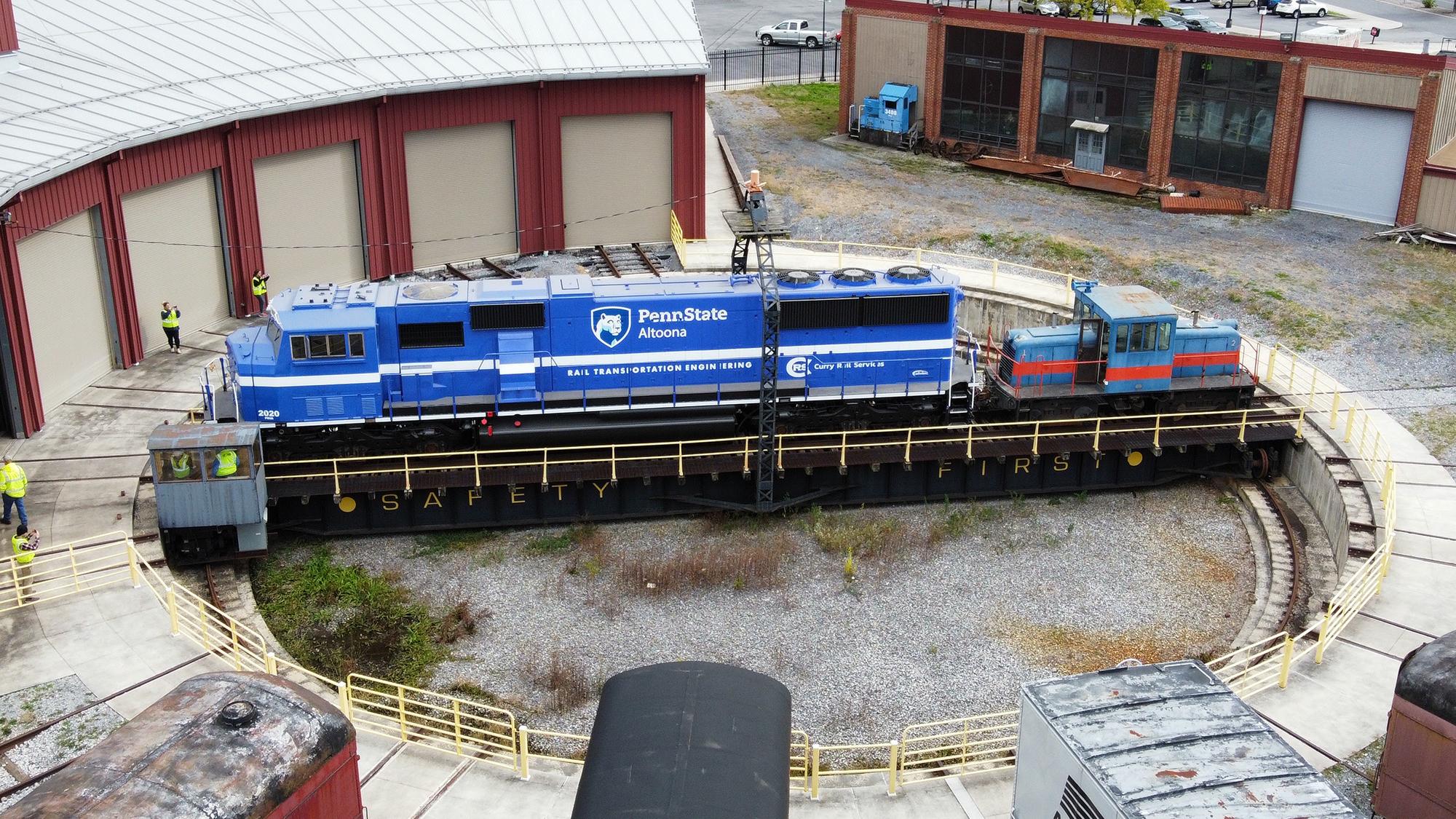
A locomotive gifted to Penn State Altoona by Norfolk Southern sits in the Altoona Railroaders Memorial Museum’s Harry Bennett Memorial Roundhouse. Used to teach Rail Transportation Engineering students about locomotive systems and components, it reflects how Penn State Altoona pairs hands-on learning with close industry partnerships to prepare graduates for rail careers. Credit: Penn State. Creative Commons
ALTOONA, Pa. — Each shift, it was up to Joe Carter to determine the movement of railcars across one of the largest yards in the country so that the trains could leave on schedule.
With more than 2,000 cars entering and leaving the yard every day, it might seem like a daunting responsibility even for a seasoned professional, let alone a recent graduate in the earliest days of his career.
But Carter wasn't deterred.
As a student in the Rail Transportation Engineering (RTE) program at Penn State Altoona, which offers the only bachelor's degree of its kind in the nation, Carter had already tackled something similar in the program's Railroad Operations Practicum course, working with a simulation program called Rail Traffic Controller.
His preparation and experiences in the program helped Carter land a job with BNSF Railway soon after graduating in the spring of 2024. He relocated to Kansas City, completed six months of management training and was eventually named a terminal train master.
Rail Transportation Engineering alumnus Joe Carter returned to Penn State Altoona as a part-time lab coordinator after working in the rail industry. His path reflects the program’s close ties between students, graduates and employers. Credit: Penn State. Creative Commons
Reflecting real-time industry needs
When the Pennsylvania Railroad was looking for ways to connect Philadelphia and Pittsburgh around the middle of the 19th century, it eventually set its sights on an undeveloped spot in central Pennsylvania at the base of the Allegheny Ridge. There, John Edgar Thomson designed the Horseshoe Curve, which enabled trains to climb the mountain at a gradual gradient. During its construction, the newly established town of Altoona served as the railroad company’s base of operations.
Less than a 10-mile drive from the Horseshoe Curve, which is still considered one of the greatest feats in railway engineering, Penn State Altoona is also close to the Altoona Railroaders Memorial Museum, several regional railroad companies and rail industry suppliers, and one of the largest locomotive repair facilities in North America.
An aerial view of the Horseshoe Curve west of Altoona, which remains an active rail line today. Its legacy, along with the industry’s continued presence in the region, helps shape the Rail Transportation Engineering program at Penn State Altoona. Credit: Penn State. Creative Commons
This proximity to the industry’s past, present and future was one of the driving factors behind the launch of the RTE program in 2016 and the creation of an advisory board to help guide it. Today, the board includes more than 30 current and retired executives from various sectors of the railroad industry.
Steve Dillen, who’s been the RTE coordinator since the program began, said the advisory board helps ensure that real-time industry needs are reflected in the curriculum. Those board members who remain active in the industry also serve as guest lecturers, host hands-on learning experiences and recruit for internships at their respective companies.
This frequent interaction between professionals and RTE students leads to a unique dynamic, Dillen said, where the students gain direct access to people with significant influence in the railroad industry, not to mention hiring power.
RTE students learn quickly that it’s a vast industry with highly specialized job opportunities. The traditional path to these positions generally begins with an engineering or a business degree. The industry-specific education occurs after being hired, through a months-long onboarding program and extensive on-the-job training.
By comparison, RTE graduates like Carter enter the workforce with mastery of industry-facing knowledge and skills, armed with a unique, trusted degree few others have and with meaningful relationships with railroad industry decision-makers.
“If a student, upon graduation, wants a job in the railroad industry, whether it’s for a railroad itself or a consulting firm or supplier, they can have any position they want,” Dillen said. “The students that want to work in a specific area, then it takes a little bit longer, but if they’re willing to go anywhere in the United States, [employers] are knocking at their door.”
‘Truly limitless possibilities’
Carter said he’s a hands-on learner who benefitted as an RTE student from regular onsite lessons, or labs as they’re called, during his junior and senior years in the program. During one session, the general manager of Everett Railroad invited Carter and his classmates to apply for part-time jobs.
Carter went on to work at Everett on weekends through his last two years at Penn State Altoona, and last fall, the company rehired him. He’s now back and working in Central Pennsylvania, closer to family, and serving as part-time RTE lab coordinator at Penn State Altoona as well — coming full circle as part of the program that gave him his start in the industry.
For Jack Proksch, a junior, the first two years in the RTE program included an array of engineering courses and other prerequisites, along with being an active member of Penn State Altoona’s student chapter of the American Railway Engineering and Maintenance-of-Way Association (AREMA).
Penn State Altoona Rail Transportation Engineering student Jack Proksch stands next to Union Pacific’s Big Boy No. 4014 locomotive. A lifelong train enthusiast, Proksch is among the students using the program’s industry connections, including a summer internship with Union Pacific, to build a career in rail. Credit: Penn State. Creative Commons
To hear Proksch describe it, the next two years are what his life has been building toward. His great grandfather was an interlocking tower operator for the Milwaukee Road. Proksch took notice of trains from an early age thanks to his encouraging father, who grew up pulling levers in his grandfather’s tower. In time, Proksch was building model trains, then photographing actual trains.
Once he discovered the RTE program, he said, Penn State Altoona was the only destination he considered for college.
This summer, Proksch worked as an intern for Union Pacific in Omaha, Nebraska. Those months were a whirlwind. Suddenly, he had an unobstructed view of the inner workings of one of the largest freight railroad companies in the world, and now, he said, the future can’t arrive fast enough.
“When I started, I was thinking maybe I’d go into design,” he said. “But now after doing all this stuff, there are so many possibilities: signaling, mechanical, track, structures. For anyone with any degree, but especially this one, there are truly limitless possibilities.”
About the series
This story is part of an ongoing Penn State News series exploring the Commonwealth Campuses and their connections to the communities they serve. The series highlights how campuses across Pennsylvania contribute to education, workforce development, research and regional engagement in unique and impactful ways.